University of Pisa
Teaching Assistant · Cloud Computing
Jan 2023 - Present
Designing and delivering the weekly laboratory sessions of the BSc Cloud Computing course through practical exercises, cloud services and project-based work.
Education
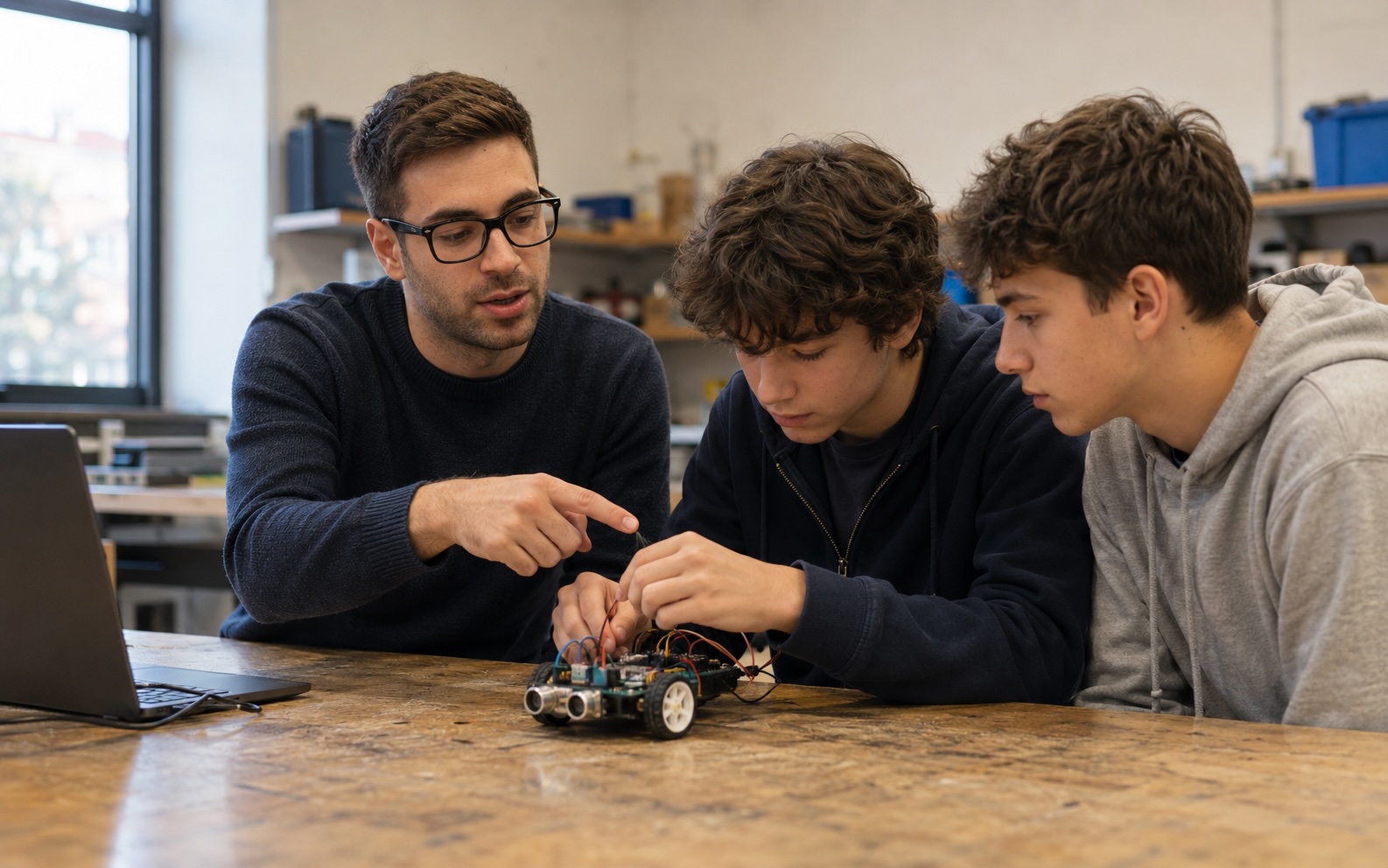
I design and deliver learning experiences in computer science, digital technologies and STEAM - from university courses to primary and secondary education. My teaching connects conceptual foundations with hands-on experimentation, projects and real technologies.
Teaching areas
Current education roles
Four current roles span university teaching, STEAM programmes, school education and applied digital-skills training. Each role shows a few representative activities; the complete record is available below.
University of Pisa
Jan 2023 - Present
Designing and delivering the weekly laboratory sessions of the BSc Cloud Computing course through practical exercises, cloud services and project-based work.
MakerDojo
Apr 2026 - Present
Designing and delivering STEAM programmes, laboratories, summer activities, teacher professional-development courses and free weekly club sessions centred on practical learning, creativity and problem solving.
I.C.S. L. Fibonacci · Pisa
Dec 2022 - Present
Designing and teaching recurring computing and educational-robotics courses spanning primary and lower-secondary education, with a progression from intuitive exploration to programming.
Fondazione ISI · Chambers of Commerce
May 2024 - Present
Applied educational programmes connecting robotics, programming and digital literacy with real-world technical contexts for students, young people and adult learners.
Mentoring
Long-term mentoring has been a parallel strand of my education work, centred on free access to computing, collaborative making and student-led projects.
Mentor · 2018–2026 · Activities & Logistics Coordinator · 2024–2026
Free programming activities for young people aged 7–17, spanning coding, digital making and community learning.
60+ meetings organised by the local community
STEAM Mentor · 2022
Mentored secondary-school students in designing an AI and high-connectivity robotics prototype for the 5GBOT competition promoted by Fondazione Mondo Digitale with the Lars Magnus Ericsson Foundation.
Teaching approach
Concepts become concrete through code, experiments, robots, systems and projects.
Activities move from intuitive exploration toward increasingly sophisticated tools and abstractions.
Technical concepts are tied to real systems, meaningful problems and tangible outcomes.
Challenges, games and projects encourage creativity, collaboration and independent problem solving.
Teaching record
A reverse-chronological record of university teaching, school programmes, STEAM laboratories, educational workshops and mentoring activities.
Weekly practical laboratories for the BSc Cloud Computing course, centred on cloud services, tools, exercises and projects.
Robot Universe and Drone Challenge programmes for learners aged 11–17, combining educational robotics, programming, drone piloting and Python.
A week-long summer programme in robotics, coding and artificial intelligence for 25 learners aged 8–14.
Introductory lecture on Quantum Software Engineering for MSc Computer Science students.
Interactive laboratory using the QTris board game as a hands-on route into quantum concepts.
Curricular laboratory on designing and developing videogames in Python with a secondary-school class.
Two practical sessions on artificial intelligence and large language models with secondary-school classes.
Training in foundational digital skills and robotics, digital citizenship, media literacy and digital soft skills for young people and adults.
Afternoon educational-robotics programme for primary-school learners.
Scratch-based computational-thinking programme for primary and middle-school learners.
Weekly practical laboratories for the BSc Cloud Computing course.
Hands-on development and execution of quantum software.
Introductory lecture on Quantum Software Engineering for MSc students.
Lego Mindstorms EV3 educational robotics for middle-school learners.
Computational-thinking activities for primary-school learners.
Three curricular PNRR courses for first-year primary classes using gamification, robots and unplugged activities.
Curricular PNRR programme for a third-year primary class using construction, gamification and introductory programming.
Afternoon Lego Mindstorms EV3 programme for middle-school learners.
Weekly practical laboratories for the BSc Cloud Computing course.
Introductory Quantum Software Engineering lecture for MSc students.
Introductory lesson on quantum programming for a mixed audience.
Hands-on programming of five 6-axis robotic arms using block programming and Python with secondary-school students.
Educational pathway introducing Quantum Computing concepts.
Public engagement activity introducing programming through micro:bit.
Unplugged summer laboratory using simple commands to program participants to draw constellations.
Lego Mindstorms EV3 robotics for middle-school students.
Scratch-based computational thinking for middle-school learners.
Afternoon Scratch-based computational-thinking course for middle-school learners.
Weekly laboratories introducing cloud services and tools through practical exercises and projects.
Introductory lecture on Quantum Software Engineering.
Practical introduction to building and running first quantum circuits.
Exploration of languages and programming approaches for pervasive parallelism.
Seminar connecting quantum computing and sustainability.
Hands-on logic-programming workshop for prospective students.
Quantum-technology educational pathway for secondary-school students.
Two Scratch-based computational-thinking courses for middle-school learners.
Computing education workshop designed as an accessible, game-like learning activity.
Mentored secondary-school students developing an AI and high-connectivity robotics prototype.
Introductory coding and physical-computing workshop using micro:bit.
Programming video tutorials for learners aged 7–17, released during the first COVID-19 lockdown and accredited within Italy’s Digital Solidarity initiative.
Hands-on educational laboratory created for the festival marking the 50th anniversary of the Moon landing.
Accessible workshop introducing blockchain concepts through a practical learning activity.
Research· Education· Communication· Advisory
A course, workshop, learning experience or educational technology project can start from a simple question: what should people be able to understand, build or explore afterwards?
Discuss an education project